Decoding Molecular Geometry: The Hidden Shapes That Dictate Life, Chemistry, and Material Science
Decoding Molecular Geometry: The Hidden Shapes That Dictate Life, Chemistry, and Material Science
The three-dimensional arrangement of atoms within a molecule, known as molecular geometry, dictates everything from the water’s surface tension to the efficacy of a life-saving drug. This invisible architecture determines molecular polarity, reactivity, and biological interaction, making it a cornerstone of modern chemistry and pharmacology. By applying principles like Valence Shell Electron Pair Repulsion (VSEPR) theory, scientists can predict and manipulate these shapes to engineer solutions for industry and healthcare.
In the controlled environment of a synthetic chemistry lab, the manipulation of molecular geometry is a daily ritual. Chemists do not merely mix reagents; they choreograph the spatial arrangement of electrons and nuclei to achieve a desired outcome. As Dr. Aris Thorne, a prominent computational chemist at the Institute for Molecular Design, explains, "We are not just observing nature’s blueprints; we are learning to read the language of 3D structure to write our own." This pursuit of structural understanding drives innovation across multiple scientific disciplines.
The foundation of predicting molecular geometry lies in the VSEPR theory, a model developed in the 1950s that remains remarkably effective. The theory is built on a simple yet powerful postulate: electron pairs around a central atom will arrange themselves as far apart as possible to minimize repulsion. This repulsion occurs between bonding pairs (shared electrons) and lone pairs (non-bonding electrons), with lone pairs exerting a greater repulsive force due to their closer proximity to the nucleus.
To determine the geometry of a molecule using VSEPR, one must follow a systematic process. First, the Lewis structure of the molecule is drawn to identify the central atom and count its electron domains. An electron domain is any bond—single, double, or triple—or lone pair surrounding the central atom. Second, the number of electron domains dictates the electron geometry, which describes the idealized arrangement of these domains in space. Finally, the positions of the atomic nuclei define the molecular geometry, which may differ from the electron geometry if lone pairs are present.
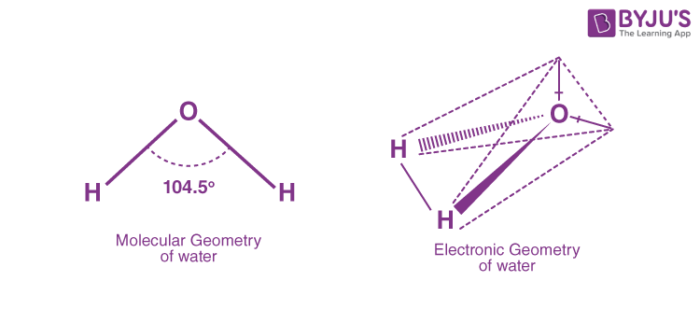
Consider the example of carbon dioxide (CO₂). The central carbon atom has two electron domains, both of which are bonding pairs. According to VSEPR, these domains will orient themselves 180 degrees apart, resulting in a linear molecular geometry. This linear shape ensures the molecule is non-polar, despite the polar carbon-oxygen bonds, because the dipoles cancel each other out. In stark contrast, water (H₂O) presents a more complex scenario. The central oxygen atom has four electron domains: two bonding pairs and two lone pairs. While the electron geometry is tetrahedral, the molecular geometry is bent. The repulsion from the two lone pairs pushes the hydrogen atoms closer together, creating an angle of approximately 104.5 degrees and giving water its distinctive polarity and life-sustaining properties.
The influence of molecular geometry extends far beyond academic exercises; it is the primary determinant of a molecule's chemical behavior. A slight change in bond angle or atomic alignment can render a harmless compound toxic or transform an inert substance into a potent catalyst. This principle is vividly illustrated in the comparison between cis and trans isomers. These are molecules with the same chemical formula but different spatial arrangements of atoms.
A classic example is cisplatin versus transplatin, two isomers of platinum-based compounds. In cisplatin, the two ammonia molecules and two chloride ions are positioned adjacent to each other on the platinum atom. This specific geometry allows cisplatin to bind effectively to DNA, disrupting replication and making it a highly successful chemotherapy agent. Conversely, transplatin, where the ligands are opposite each other, lacks this biological activity. As oncologist Dr. Lena Petrova notes, "The difference between a cure and a null effect can be a few degrees of atomic rotation. Geometry is the difference between medicine and poison."
The pharmaceutical industry relies heavily on molecular geometry during the drug discovery process. Most biological targets, such as enzymes or receptors, are proteins with three-dimensional active sites. A drug molecule must fit precisely into this site, much like a key into a lock, to be effective. This concept is known as the "lock and key" model. If the stereochemistry—the 3D orientation of atoms—is incorrect, the drug will not bind efficiently, regardless of its chemical potency. Thorne elaborates on this critical application: "We are designing molecules not just to interact with a target, but to interact *correctly*. We need to ensure the hydroxyl group is here, the aromatic ring is there, to induce the correct conformational change in the protein."
Furthermore, molecular geometry plays a crucial role in materials science, influencing the properties of polymers, ceramics, and nanomaterials. The rigidity of Kevlar, the flexibility of polyethylene, and the conductivity of graphene are all direct consequences of how the molecules are arranged in space. In high-performance polymers, specific geometric configurations allow for strong intermolecular forces like hydrogen bonding or pi-stacking, which impart incredible strength and thermal stability. Understanding these arrangements allows engineers to tweak molecular structures to develop lighter, stronger, and more durable materials for aerospace, construction, and consumer goods.
Advanced spectroscopic techniques such as X-ray crystallography, nuclear magnetic resonance (NMR) spectroscopy, and cryo-electron microscopy serve as the eyes of modern science, allowing researchers to visualize molecular geometry with atomic precision. X-ray crystallography, for instance, measures the diffraction pattern of X-rays passing through a crystalline solid to map the electron density and determine atomic positions. These experimental methods are often complemented by computational modeling, where supercomputers simulate the behavior of molecules based on quantum mechanical principles. This synergy between experimentation and calculation has led to breakthroughs in understanding complex systems like enzymes involved in disease or novel superconductors.
Despite its predictive power, VSEPR theory is not without limitations. It is a qualitative model that provides a general guideline rather than an exact description of reality. It does not account for subtle differences in bond lengths or the effects of orbital hybridization, which is the mixing of atomic orbitals to form new hybrid orbitals suitable for bonding. More sophisticated theories, such as Molecular Orbital Theory, provide a more detailed picture of electron distribution but are mathematically complex. Nevertheless, VSEPR remains the go-to tool for quickly visualizing and understanding the basic shapes of molecules, from the tetrahedral methane (CH₄) to the octahedral sulfur hexafluoride (SF₆).
As science progresses, the importance of molecular geometry is only increasing. The field of nanotechnology, which deals with materials at the atomic or molecular scale, is entirely dependent on precise geometric control. Researchers are now able to construct "molecular machines"—tiny devices comprised of a few atoms—that can perform tasks like moving molecules or converting energy. These machines hold the promise of revolutionizing computing, medicine, and energy production. The ability to manipulate matter at this level requires an intuitive grasp of how atoms connect and orient themselves.
In the grand tapestry of science, molecular geometry is the thread that weaves together structure and function. It is the silent architect behind the diversity of the natural world and the ingenious designer of future technologies. By mastering the principles of shape and arrangement, scientists are not merely observing the universe; they are gaining the ability to reshape it, molecule by molecule, for the betterment of society. The invisible shapes that govern our material world are finally stepping into the light, revealing their profound impact on our existence.
Related Post
The Bent Geometry Puzzle: Why Water and Other Molecules Don’t Line Up Straight
The Seesaw Molecular Geometry: Decoding the Unique 3D Shape of SF4 and Its Chemical Kin
Electron Geometry vs Molecular Geometry: The Atomic Shape Revolutionizing Reactivity and Function
Electron Geometry vs. Molecular Geometry: Decoding the Shape of Molecules in Chemistry


