Grayson County Judicial Records: Your Complete Guide to Accessing Court Records Online
Grayson County Judicial Records: Your Complete Guide to Accessing Court Records Online
Grayson County judicial records offer the public a transparent window into the local legal system, detailing everything from traffic violations to complex civil disputes. These official documents, maintained by the county clerk and various courts, are essential for verifying case histories, conducting background checks, and understanding legal outcomes. This guide provides a clear roadmap for locating and interpreting these vital public records.
The justice system relies on public scrutiny to maintain integrity, and Grayson County judicial records serve as the foundational evidence of that process. For journalists, researchers, and concerned citizens, the ability to access these files is not merely a convenience but a cornerstone of civic transparency. Below is a detailed analysis of how these records are structured, maintained, and accessed.
### The Legal Framework and Public Right to Access
Public access to court records is a fundamental principle embedded in the American legal system, rooted in the idea that courts are government agencies and their proceedings should not be shrouded in secrecy. In Grayson County, this access is governed by the Texas Public Information Act, which presumes that all government information—including court filings—is open to citizens unless specifically exempted by law.
This right ensures accountability. When a case involving a public official or a matter of public interest arises, the availability of records allows the community to assess the performance of the judiciary and the conduct of legal professionals.
* **Presumption of Openness:** The law favors disclosure. Government bodies, including the Grayson County clerk's office, must make records available unless they can justify a specific reason for confidentiality.
* **Exemptions:** Certain records are sealed to protect privacy or the integrity of an ongoing investigation. Examples include juvenile records, cases involving family violence, or documents containing sensitive financial information sealed by court order.
* **Balancing Test:** If a specific piece of information is contested, the court weighs the public's interest in disclosure against the potential harm that release might cause.
### Navigating the Grayson County Clerk’s Office
The primary custodian of Grayson County judicial records is the County Clerk’s office. This entity is responsible for the filing, indexing, and storage of all documents related to legal proceedings in the county, ranging from civil lawsuits to criminal dockets. The clerk acts as the official record-keeper, ensuring that the chain of custody for each document is maintained.
For individuals seeking information, the clerk’s office is the first point of contact. While in-person visits are traditional, many jurisdictions now offer digital access, streamlining the process for those who cannot visit the physical location.
**Key Responsibilities of the Clerk's Office:**
1. **Filing:** Accepting new legal documents and entering them into the court’s docket.
2. **Indexing:** Organizing records in a searchable database, usually by case number, party name, or case type.
3. **Storage:** Maintaining physical files for historical reference and ensuring digital backups exist.
4. **Vital Records:** Issuing certified copies of birth, death, and marriage certificates (though this is distinct from judicial records, it is a core function of the same office).
### Methods of Access and Practical Considerations
Obtaining Grayson County judicial records has evolved significantly with technology. While the traditional walk-in method remains viable, digital access often provides a faster and more convenient alternative. It is important to understand the costs associated with these searches and the limitations of the data available.
**In-Person Requests**
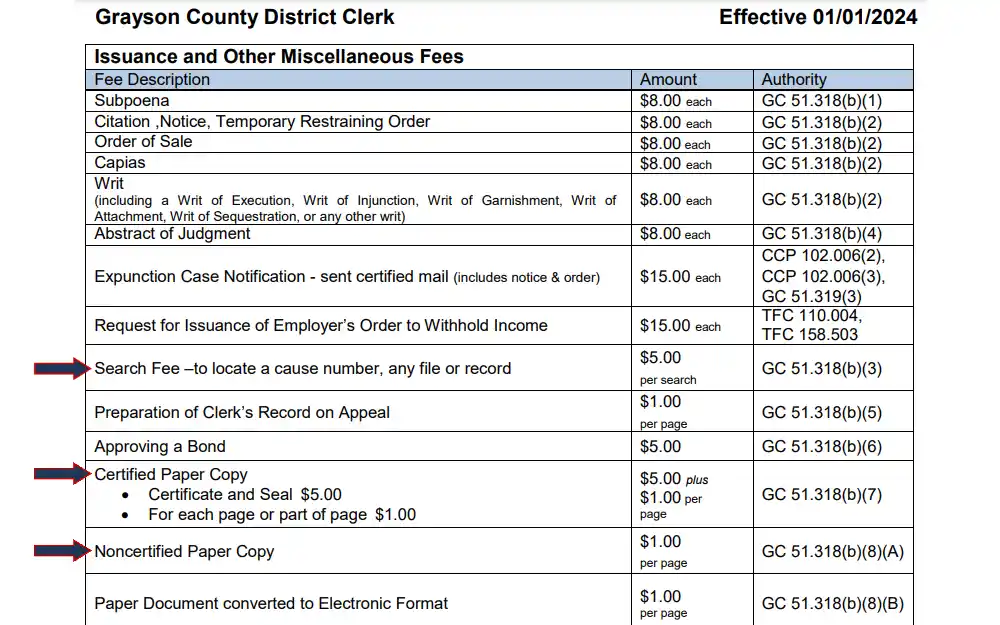
Visiting the clerk’s office allows for immediate inspection of physical files. This is often necessary if you require certified copies or need to review documents that have not been digitized. Be prepared to pay a fee per page for copying and potentially a fee for certification.
**Online Portals**
Many counties utilize third-party vendors or internal systems to provide online case search. These platforms allow users to search by name, case number, or filing date. While convenient, these systems may not include every document, such as scanned images of handwritten notes or exhibits submitted as evidence.
**Mail or Fax Requests**
For those who cannot visit in person or use the internet, submitting a written request with specific case details is an option. This method is slower and requires clear documentation to ensure the correct files are retrieved.
### Understanding the Information Within the Records
A Grayson County judicial record is not a single page but a compilation of documents that tell the story of a legal case. Deciphering these files requires an understanding of the common components found within a docket.
**The Docket Sheet**
This is the master index for a case. It lists every filing, hearing, and ruling in chronological order. It provides the case number, the names of the parties involved, the judge assigned, and the dates of all key events.
**Pleadings**
These are the formal written statements by the parties outlining their claims or defenses. In a civil case, this includes the Original Petition (the complaint) and the Answer (the response). In criminal cases, this includes the Indictment or Information filed by the state.
**Motions and Orders**
Motions are requests made to the court to compel a specific action, such as forcing the other party to provide evidence or to dismiss a case. Orders are the judge’s written decisions on those motions.
**Judgment and Sentencing**
The final document in most cases is the judgment, which states the court's decision. In criminal cases, this is followed by a sentencing order that details the punishment imposed, whether it is a fine, probation, or incarceration.
### Limitations and Ethical Considerations
While the law grants broad access to judicial records, there are practical and ethical hurdles to consider when researching or reporting on these documents. The information contained in these files is often raw and unfiltered, containing allegations that may never be proven in a court of law.
Journalists, in particular, must balance the public's right to know with the protection of due process. Publishing details of an arrest or a sealed record can prejudice a potential jury pool or violate the privacy of minors.
Furthermore, the volume of data can be overwhelming. A single complex case may generate hundreds of pages of documents. Distinguishing between relevant evidence and procedural noise requires careful analysis.
**A Note on Context:**
> "A docket number is a snapshot in time. It captures the legal strategy and the factual disputes of a specific moment, but it does not necessarily capture the entire truth of what happened," explains a local legal expert familiar with Grayson County operations. "These records are tools for understanding the process, but they must be interpreted with care and corroborated with other evidence."
Related Post