How Do You Make TNT In Minecraft: The Complete Guide To Crafting Explosives
How Do You Make TNT In Minecraft: The Complete Guide To Crafting Explosives
In the blocky world of Minecraft, TNT remains one of the most iconic and destructive tools available to players. Created through a precise combination of resources and arranged in a specific pattern during the crafting process, this explosive device can reshape landscapes and clear obstacles with devastating efficiency. Understanding how to produce TNT effectively is essential for both survival gameplay and complex redstone engineering projects, making it a fundamental skill for any dedicated player.
The crafting of TNT relies on a simple yet critical recipe that has remained consistent across game versions, though the acquisition of its components presents a significant challenge for new players. To successfully create this powerful item, one must first secure the two key ingredients and understand the exact crafting grid layout required to trigger the chemical reaction. This guide provides a comprehensive breakdown of the materials, the crafting method, and the practical applications of this explosive block.
The Fundamental Components Required
Before a player can even consider igniting the fuse, they must overcome the primary obstacle: gathering the necessary resources. TNT does not drop naturally in the game world and cannot be obtained through chest loot in a ready-made form, requiring players to actively farm the materials themselves. The entire production process revolves around two specific elements: Gunpowder and Sand.
Gunpowder is the volatile compound that provides the explosive energy, while sand acts as the inert filler that stabilizes the mixture into a usable block form. The rarity of these components directly dictates the time investment required to produce a single batch of explosives.
Acquiring Gunpowder
Gunpowder is the more difficult of the two resources to obtain, as it is not found in standard ore deposits. Instead, it is a rare drop from specific hostile mobs that players encounter in the game world. The primary sources of gunpowder include:
* **Creepers:** The iconic green exploding mob is the most consistent drop of gunpowder in the game. Players often engage in "creeper farming" or simply hunt these creatures in dark areas to collect this essential material.
* **Ghasts:** These floating, ghost-like monsters found in the Nether dimension drop a substantial amount of gunpowder when defeated with a projectile, such as an arrow or a fireball.
* **Witches:** These hostile NPCs that spawn in swamp biomes or during thunderstorms have a chance to drop gunpowder along with other various magical items.
* **Chest Loot:** While less reliable, gunpowder can occasionally be found in dungeon chests, temple chests, or bastion remnant chests located in Nether fortresses.
Sourcing Sand
Sand is a significantly more common resource, making up the bulk of the TNT composition. It is found in large quantities in specific biomes and environments.
* **Beaches:** Coastal areas generate vast amounts of sand, providing an easy renewable source if the player has access to water.
* **Riverbeds:** The flowing water of rivers often contains sand blocks on the bottom.
* **Deserts:** The expansive desert biome is covered in sandstone, which can be mined to produce sand blocks.
* **Trading:** Players can also trade with wandering traders or villagers who sell sand blocks, though this is a more expensive option.
The Crafting Process Explained
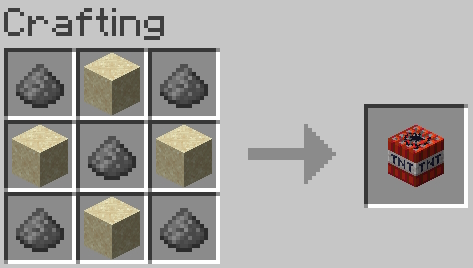
Once a player has accumulated five units of Gunpowder and four units of Sand, the actual creation of the TNT block can begin. It is important to note that TNT cannot be crafted in a standard 2x2 crafting grid found in the inventory; it requires the precision of the 3x3 crafting table interface.
The arrangement of the items is not random; it follows a specific pattern that mimics a "checkerboard" or "cross" shape. If the items are placed incorrectly, the crafting grid will simply display the items as ghosted images, refusing to combine them into the final product.
To craft TNT, follow these steps:
1. Open the 3x3 crafting table menu.
2. Place **Gunpowder** in the center slot of the grid.
3. Place **Sand** in the four diagonal slots surrounding the center (top-left, top-right, bottom-left, bottom-right).
4. The resulting five empty slots in the pattern should remain vacant.
Following this pattern correctly will result in the appearance of the TNT icon in the result box, yielding one block of TNT per craft. The process is highly efficient, converting 5 Gunpowder and 4 Sand into a single, powerful explosive block ready for deployment.
Strategic Applications And Safety
TNT serves multiple purposes in the Minecraft universe, ranging from basic mining to high-level engineering. However, due to its nature, it requires careful handling to avoid self-inflicted damage.
One of the most popular uses for TNT is in the creation of automatic mining systems, often referred to as "TNT dupers" or tunnel borers. By using Redstone circuitry to place and ignite TNT blocks sequentially, players can clear massive trenches or mine deep underground layers with minimal manual labor. This method is exponentially faster than traditional pickaxe mining, especially when clearing large areas of stone or gravel.
Redstone engineers utilize TNT in complex builds to create timed explosions, trap mechanisms, or decorative displays such as fireworks. The timing of these explosions can be controlled using repeaters and pulse extenders, allowing for intricate sequences.
Despite its utility, players must exercise caution. TNT is indiscriminate and will damage or destroy blocks, items, and entities caught in the blast radius, including the player who triggered it if they are too close. To utilize TNT safely, it is recommended to activate it from a distance using a Flint and Steel or a Redstone signal, ensuring the player remains outside the blast zone to avoid taking fatal explosion damage.
Related Post