Insignia Portable Air Conditioner 2024 Review: Can This Budget Unit Cool Your Space?
Insignia Portable Air Conditioner 2024 Review: Can This Budget Unit Cool Your Space?
Across North America, rising energy costs and increasingly intense summer heat waves are pushing homeowners to seek flexible, cost-effective cooling solutions. The Insignia portable air conditioner has emerged as a prominent option in the mass-market segment, offering a do-it-yourself alternative to complex window installations or central air upgrades. This article examines the technical specifications, real-world performance data, and user-reported experiences associated with this specific unit to determine its place in the current appliance market.
The Insignia line, sold exclusively through major retailers like Best Buy, targets budget-conscious consumers who require spot cooling in bedrooms, home offices, or garage spaces. Unlike traditional ductless mini-splits or fixed window units, these devices operate as standalone systems, venting hot air through a flexible hose to an external window or wall kit. While the promise of "portable" comfort is attractive, the technology involves specific limitations regarding thermodynamics and room volume that potential buyers must understand.
Understanding Portable Air Conditioner Mechanics
To evaluate the Insignia Portable Air Conditioner, one must first understand the basic principles of how portable units function. All air conditioners operate on the same fundamental science: the phase change of a refrigerant that absorbs heat from indoor air and expels it outside. Portable units achieve this through a closed-loop system involving four primary components—the evaporator, compressor, condenser, and expansion device.
The process begins when the fan pulls warm room air across the cold evaporator coils. The refrigerant inside these coils absorbs the thermal energy, causing the liquid to evaporate and cool the air that is pushed back into the room. The gaseous refrigerant is then compressed, which increases its temperature and pressure. This hot gas is passed through the condenser coils, where a second fan dissipates the heat to the external environment. Finally, the refrigerant passes through an expansion valve, cooling it down to begin the cycle again. This is the same vapor-compression cycle used in refrigerators, but adapted to condition a room's air rather than preserve food.
Single Hose vs. Dual Hose Technology
A critical differentiator in portable AC performance is the venting configuration, specifically the difference between single-hose and dual-hose systems. The Insignia portable air conditioner typically utilizes a single-hose design, which has implications for energy efficiency and cooling speed.
In a single-hose unit, the air is drawn in from the room to cool the hot condenser coils, and the hot exhaust is vented outside through the same hose. While this design is generally less expensive to manufacture, it creates a negative pressure differential in the room. Because the unit is exhausting air, it effectively lowers the air pressure inside the space, which can cause the unit to inadvertently suck in warm air from adjacent rooms or from gaps around doors and windows. This "reverse flow" effect forces the unit to work harder to cool the space, increasing energy consumption and reducing the speed of temperature reduction.
Dual-hose units, which are more common in higher-end models, separate the intake and exhaust flows. One hose pulls in fresh air from outside for cooling, while another expels the hot air. This design maintains neutral room pressure and allows for faster cooling with greater efficiency. However, the trade-off is usually a higher price point and increased bulk.
Performance Specifications and Real-World Application
The Insignia portable air conditioner is typically rated at 8,000 or 10,000 British Thermal Units (BTUs), placing it in the "small room" category of portable cooling. According to the manufacturer’s specifications, the unit is designed for spaces up to 350 or 400 square feet respectively. However, industry experts suggest that these numbers represent ideal laboratory conditions rather than typical living environments.
"The cooling capacity of a portable AC is heavily dependent on ambient conditions, insulation, and the age of the building," notes HVAC consultant Maria Lopez. "A unit rated for 400 square feet in a laboratory with perfect insulation will struggle significantly in a drafty 1970s-era bedroom with single-pane windows."
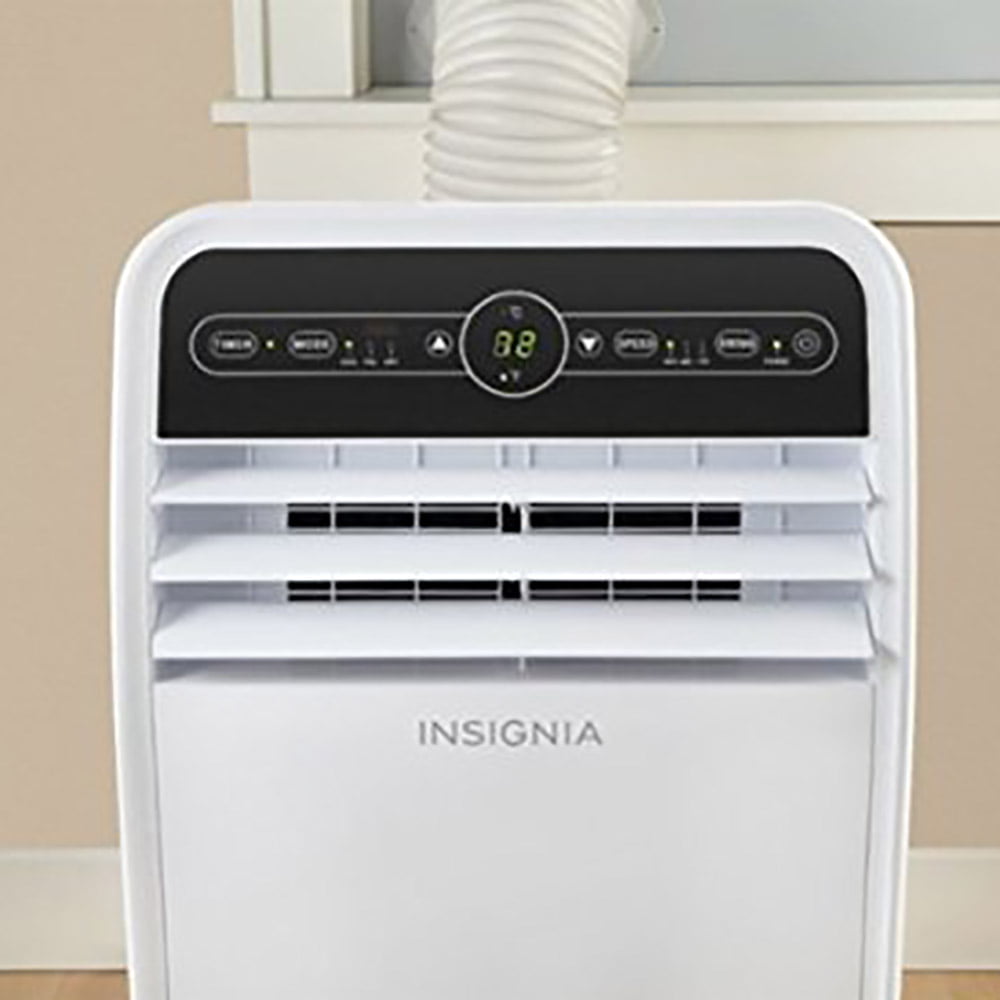
In practical terms, the Insignia unit is best suited for cooling a single small room or a large zone in an open-plan area. Users reporting on retail sites often mention using it successfully in home offices (up to 200 sq ft) or as a supplementary cooling source in bedrooms at night. The unit usually features three fan speeds and a dehumidification mode, which is arguably one of its most valuable functions. Even on days that are not hot but are humid, the unit can pull moisture from the air, increasing comfort without dropping the temperature significantly.
Installation and Portability Factors
The "portable" label implies that the unit can be moved easily from room to room, and this is largely true regarding physical weight and the presence of integrated casters. The Insignia unit usually features a handle and wheels, allowing a user to wheel it from a bedroom to a living room as needed. However, the portability is constrained by the requirement for a window venting kit.
Every portable air conditioner requires an opening to the outside to vent the heat. The Insignia kit typically includes a window panel that slides down, and the user anchors the vent hose between the panel and the window frame. While this is a straightforward DIY task for most homeowners, it does require the window to be large enough to accommodate the specific panel. In apartments or buildings with restrictive window types, this installation step can prove to be difficult or even impossible without modifications.
Energy Efficiency and Operational Costs
Potential buyers are often attracted to portable air conditioners due to the perception of lower operating costs compared to running a central air system. While it is true that cooling a single room with a portable unit uses less electricity than cooling an entire house, consumers should be aware that portable units are generally the least efficient type of air conditioner on the market.
Because the compressor technology in portable units is smaller and less optimized than that of a split-system or central air conditioner, and because of the single-hose negative pressure issue mentioned earlier, these units often draw more power per degree of cooling than other systems.
* **Typical Power Draw:** The Insignia 8,000 BTU unit usually operates at around 900 to 1,000 watts on high.
* **Estimated Cost:** Assuming an average US electricity rate of $0.15 per kilowatt-hour, running the unit for 8 hours a day for a month would cost approximately $36 to $48.
* **Standby Mode:** It is important to note that many portable units draw power even when "off" if the remote is used, due to the display or clock. Users should plug the unit into a switched outlet to fully eliminate phantom loads.
User Experience and Common Complaints
Analyzing user reviews provides insight into the day-to-day reality of owning an Insignia portable air conditioner. Reviewers frequently praise the unit for its affordability and immediate relief on hot days. The remote control functionality and digital display are generally regarded as modern and convenient features.
However, certain recurring complaints are critical for a potential buyer to consider.
1. **Noise Level:** All air conditioners generate noise, but portable units are often louder than window units due to the smaller compressor and the vibration of the unit on a hard floor. Many users describe the sound as a constant "whoosh" or "rattle," which can be disruptive in quiet environments like bedrooms or home offices.
2. **Water Drainage:** The unit removes humidity from the air, which must be collected in an internal bucket or drained via a hose. In dehumidification mode, the bucket can fill up quickly, requiring frequent manual emptying. While some models offer a continuous drain option via a hose, users must ensure the drainage point is lower than the unit to prevent backflow.
3. **Heat Bleed:** In single-hose units, the exhaust hose brings hot air back near the unit. If the hose is long or kinked, or if the ambient temperature is very high, this hot air can partially recirculate into the room, diminishing the overall cooling effect.
Market Context and Competitor Considerations
The portable air conditioner market is crowded, ranging from budget models at big-box stores to high-end units from brands like Midea, LG, and Frigidaire. The Insignia brand, sold by Best Buy, occupies the lower-mid price range. Its primary competitors are brands like Honeywell and Whynter, which also offer dual-hose options.
Choosing the Insignia unit is usually a decision driven by price and availability. For renters, individuals in temporary housing, or those who only need to cool a room for a few months of the year, the low upfront cost is a significant advantage. However, for users who plan to use the unit for many years, investing in a dual-hose portable unit or a mini-split system may provide better long-term value in terms of energy savings and comfort.
Ultimately, the Insignia Portable Air Conditioner is a functional appliance that fulfills its basic promise. It moves cool air from the outside to the inside, lowering the temperature in a contained area. Potential buyers must temper their expectations regarding speed and efficiency, viewing the purchase as a practical solution for specific, limited-use scenarios rather than a comprehensive home cooling strategy.
Related Post
Stay Cool and Save Big: The Insignia Portable Air Conditioner Review


