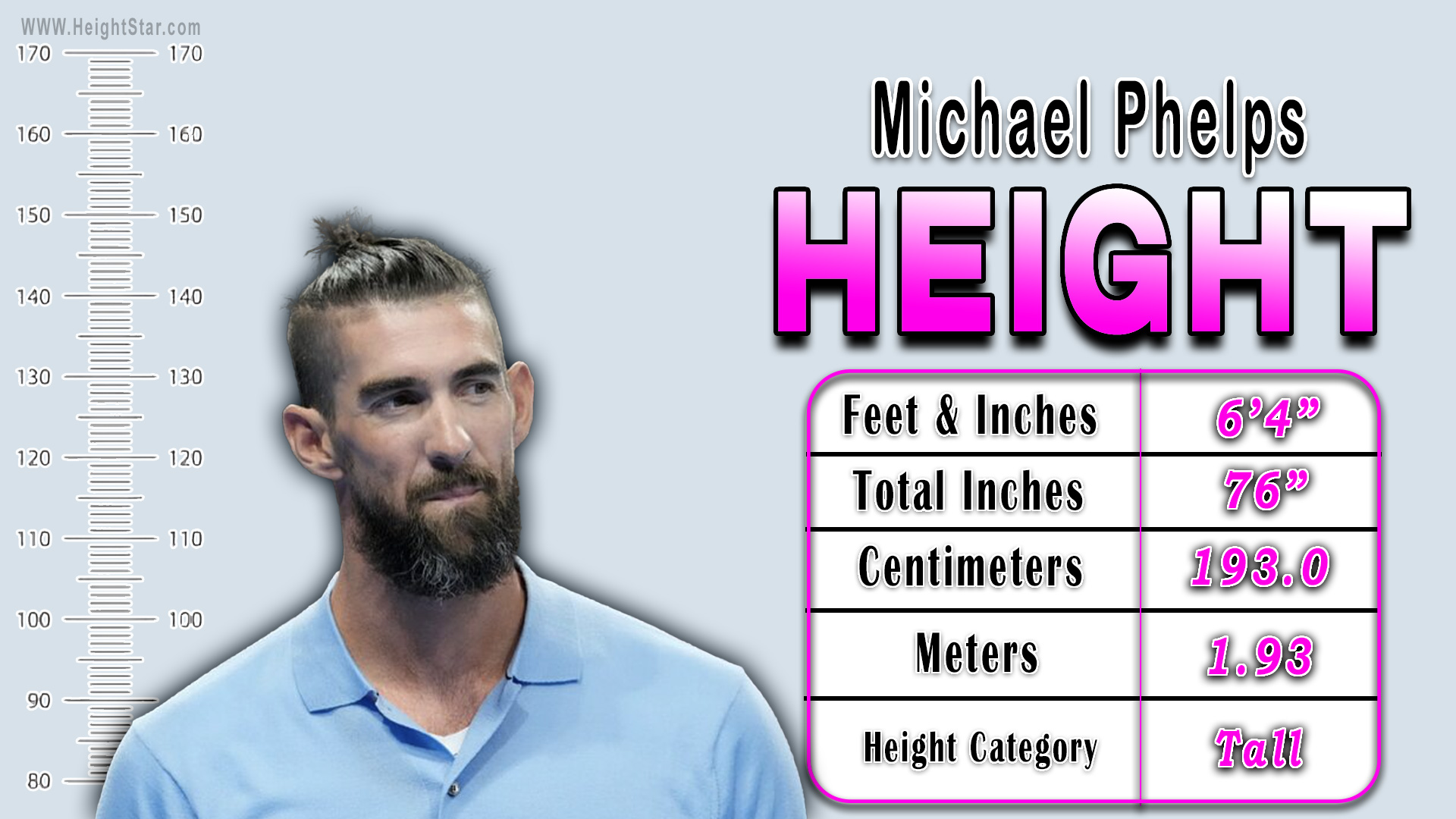
Michael Phelps Height: How The 6'4" Physique Fueled Olympic Dominance
Michael Phelps Height: How The 6'4" Physique Fueled Olympic Dominance
At six feet four inches, Michael Phelps possesses a physical anomaly in the pool, a wingspan that functions as a biological advantage rather than a simple measurement. His height dictates the hydrodynamics of his stroke, transforming the water into a domain where his proportions allow for a near frictionless glide that shorter competitors cannot replicate. This article dissects the science behind his stature, exploring how a frame often compared to that of a basketball player became the cornerstone of the most decorated Olympian in history.
The conventional narrative of an Olympic champion often focuses on discipline, technique, and sheer willpower, and Phelps embodies these virtues. However, lurking beneath the surface of his legendary work ethic is a genetic lottery win that provided a foundation impossible to build from scratch. His height is not merely a detail; it is a structural pillar supporting his unprecedented success. To understand Michael Phelps the athlete, one must first understand the machine his body became, a machine calibrated in part by the six-foot-four frame that entered the water.
**The Biological Blueprint: Wingspan and the Physics of Propulsion**
In the world of elite swimming, the ratio of wingspan to height is a critical data point, a measure of leverage and surface area. Phelps’s wingspan is officially listed at 6 feet 7 inches, a full three inches taller than his actual height. This discrepancy, known as an ape index, creates a powerful mechanical advantage.
* **Leverage and Reach:** Every pull creates a wider arc, covering more distance per stroke. While a swimmer of average height might need to take 50 strokes to cover a length of the pool, Phelps’s extended reach allows him to complete the same distance in significantly fewer strokes. This efficiency conserves energy, a crucial factor in events ranging the length of a sprint to the grueling 400 meters.
* **Hydrodynamic Efficiency:** The human body displaces water, creating resistance. A taller, longer frame slices through the water with a leading edge that minimizes splash and turbulence. Phelps’s torso and arms act like a hydrofoil, cutting a clean path rather than pushing against the resistance of the pool. His large hands and feet function as paddles and fins, increasing the surface area for propulsion without sacrificing the streamlined shape of his body.
“Michael is built like a professional football player or a basketball player,” stated Bob Bowman, Phelps’s longtime coach and mentor, reflecting on the physical outlier. “He is not just a swimmer; he is a genetic specimen whose body is specifically designed to move through water efficiently.” This design allowed him to generate power with less effort, translating into sustained speed over distances that would exhaust the average elite athlete.
**The Drag Dilemma: Size in the Water**
While the advantages of height are substantial, they are not without their physical paradoxes. In fluid dynamics, a larger body creates more drag, the resistance that pushes against an object moving through water. For many swimmers, reducing drag is as important as generating propulsion. However, Phelps managed to turn this potential liability into another asset.
His training regimen, supervised by Bowman, focused on maintaining a physique that maximized power while minimizing unnecessary bulk. He possessed a V-shaped torso, with a broad chest and slender waist, which helped his body maintain a horizontal position in the water.
* **Core Strength:** A powerful core allowed him to maintain this ideal alignment, preventing his legs from sinking—a common problem for taller swimmers whose center of gravity is higher in the water.
* **Stroke Adaptation:** Coaches noted that Phelps’s high-elbow catch technique allowed him to anchor his strokes effectively, using the water as solidly as if he were gripping a wall. This technique, combined with his flexibility, ensured that his considerable height did not translate to clumsiness in the pool.
This ability to control his massive frame is a testament to the precision of his athleticism. Height provided the raw material, but years of meticulous training provided the control necessary to weaponize it.
**The Historical Context: Evolution of the Ideal Swimmer**
Looking back at Olympic history, the archetype of the swimmer has evolved. In the early 20th century, the ideal swimmer was often compact and powerful, relying on a rapid leg kick and a compact stroke. As the decades progressed, the physics of the sport shifted the ideal toward taller, longer physiques.
Before Phelps emerged, the record books were littered with champions of more average height. Mark Spitz, a dominant force in the 1972 Olympics, stood 6 feet tall—a significant height for his era. In the 21st century, the trend accelerated.
1. **The 1990s:** Swimmers like Alexander Popov (6'2") demonstrated the growing advantage of height in sprint events.
2. **The 2000s:** Thorpechampionships saw the rise of the "water polo" swimmer, with tall, powerful frames dominating the middle distances.
3. **The 2010s:** Phelps’s protégé, Caeleb Dressel, although shorter at 6 feet, utilizes a rigid torso and explosive power that echoes the efficiency first popularized by the taller generation.
Phelps stands as the pinnacle of this evolutionary trend. His height allowed him to excel in every stroke, from the explosive turn of the Butterfly to the endurance-based crawl. He did not just compete; he redefined the physical limits of his sport.
**Beyond the Numbers: The Adaptation of the Athlete**
Despite the clear advantages conferred by his frame, Phelps had to adapt his technique to fit his unusual proportions. A common misconception is that his size made him naturally graceful in the water. In reality, his wingspan required specific adjustments to prevent energy leaks.
* **The Kick:** Many tall swimmers rely heavily on their leg muscles for propulsion. Phelps, however, utilized a more subtle, two-beat kick that provided balance and positioning rather than raw power. This preserved his leg muscles for the final, critical meters of a race.
* **The Breath:** Turning the head to breathe can disrupt the streamline position. Phelps’s long neck and flexible spine allowed him to rotate his body efficiently, taking a quick breath without breaking the hydrodynamic flow of his stroke.
* **The Start:** A tall swimmer often has a disadvantage on the block, as their center of gravity is higher. Phelps overcame this with explosive power, launching himself into the water with a force that negated any initial height disadvantage.
These adjustments highlight that while his height provided the blueprint, his mastery of the craft was the result of relentless, intelligent training. He did not simply rely on his physiology; he honed it into a perfect instrument.
**The Verdict: A Legacy Etched in Water**
Michael Phelps height was more than a biographical footnote; it was the central axis around which his athletic career was built. It provided the wingspan for efficiency, the leverage for power, and the physical canvas upon which the greatest aquatic performer of all time painted his legacy. While statistics like medals and records measure success, the story behind them is one of a unique physical gift meeting extraordinary discipline.
Standing at the edge of the pool, observing the competition, Phelps was a living reminder that in the high-stakes world of professional sport, the human body is the ultimate piece of equipment. His 6'4" frame cut through the water not just as a vessel for movement, but as a statement of biological perfection, proving that sometimes, the greatest advantage is the one you are born with.
Related Post

Unlocking the Secret to Michael Phelps' Dominance: Unpacking His Height in Cm