Sin Cos Tan: The Indispensable Trigonometric Triad Powering Modern Reality
Sin Cos Tan: The Indispensable Trigonometric Triad Powering Modern Reality
From the silent orbits of distant galaxies to the smartphone in your pocket, the invisible architecture of the universe is often measured in angles and ratios. Sin Cos Tan, the fundamental trigonometric triad, provides the precise language to describe these relationships between the sides and angles of a right-angled triangle. This article explores how these three specific functions underpin everything from the blueprints of our buildings to the algorithms governing our digital lives, revealing the profound practicality hidden within abstract mathematical concepts.
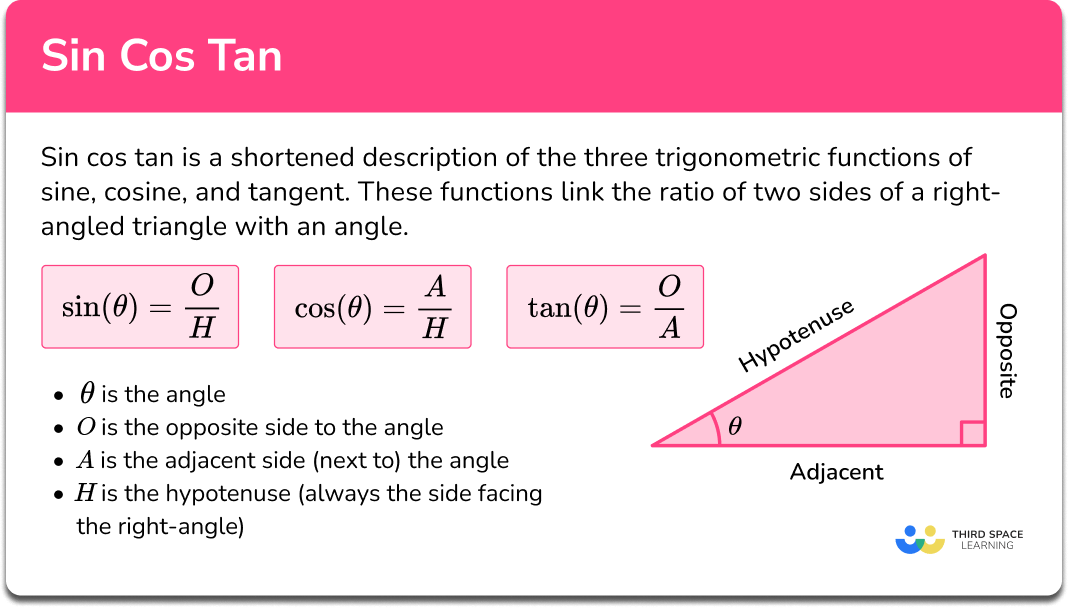
In the realm of mathematics, trigonometry stands as a discipline dedicated to the study of triangles and the cyclical nature of waves, with Sin Cos Tan serving as its primary pillars. The sine of an angle (sin) calculates the ratio of the length of the opposite side to the hypotenuse, the cosine (cos) finds the adjacent side over the hypotenuse, and the tangent (tan) divides sine by cosine to compare the opposite and adjacent sides directly. While the origins of these principles trace back to ancient astronomers charting the heavens, their modern applications are remarkably diverse and deeply integrated into contemporary technology.
Architectural Precision and Structural Integrity
Before a single brick is laid or a digital model is rendered, engineers rely on Sin Cos Tan to ensure that structures rise safely and efficiently against the forces of gravity and wind. The load-bearing capacity of a bridge cable, the pitch of a roof, and the stability of a skyscraper all depend on precise angular calculations. Without these functions, the complex geometries of modern architecture would be impossible to design or verify.
Consider the construction of a simple gable roof. To determine the length of the rafters, contractors must know the angle of the roof slope and the width of the building. By applying the cosine function, they can calculate the horizontal run, while the sine function helps determine the vertical rise. The tangent function is then used to verify the slope ratio, ensuring the roof drains water effectively and meets safety standards. These calculations are not merely theoretical; they are the difference between a stable home and a catastrophic failure.
Navigating the Physical World
Navigation, both ancient and modern, is fundamentally rooted in the application of Sin Cos Tan. Long before GPS satellites orbited the Earth, mariners used sextants to measure the angle between the horizon and celestial bodies like the sun or stars. By inputting these angles into trigonometric formulas involving sine and cosine, they could triangulate their position on the globe with remarkable accuracy.
Today, the principle remains the same, even if the tools have evolved. GPS systems calculate your location by measuring the distance from multiple satellites. These distance calculations involve solving complex trigonometric equations that rely heavily on the sine and cosine laws to pinpoint a specific coordinate on the earth’s curved surface. Similarly, the autopilot systems in aircraft use tangent calculations to maintain a constant heading and altitude, adjusting for wind shear and other environmental factors in real-time.
Digital Signals and Wave Mechanics
Perhaps the most pervasive, yet invisible, application of Sin Cos Tan is in the field of electronics and signal processing. Alternating current (AC) electricity, which powers our homes, is described by a sine wave. The voltage at any given moment in time follows a sinusoidal pattern, rising and falling in a predictable rhythm. Understanding this wave is crucial for designing everything from power generators to household appliances to ensure they operate efficiently and safely.
In the digital realm, Sin Cos Tan are the bedrock of Fourier analysis, a mathematical technique that decomposes complex signals into their constituent sine and cosine waves. This is how your phone compresses a voice recording, how JPEG files shrink images without significant quality loss, and how noise-canceling headphones generate the inverse sound wave to silence ambient noise. As Dr. Emily Carter, a leading signal processing engineer at TechInnovate Labs, explains, "The digital world is a symphony of waves, and Sin Cos Tan are the notes we use to compose the music. Without them, modern communication and media as we know them would simply not exist."
Computer Graphics and Animation
The immersive worlds of video games and blockbuster movies are brought to life through the calculated manipulation of light and motion, a process that relies heavily on trigonometric functions. When a 3D character rotates its arm or a camera swoops through a virtual landscape, the software must calculate the new position of thousands of points in space. This involves using sine and cosine to rotate objects around a central axis and tangent to simulate the depth and perspective of the scene.
In physics-based animations, such as the trajectory of a projectile or the swing of a pendulum, the tangent function is used to determine the angle of impact and the resulting force. Game engines utilize these calculations millions of times per second to create the illusion of realistic movement. The smooth arc of an arrow in flight or the realistic bounce of a ball are direct results of programmers harnessing the power of Sin Cos Tan to mimic the laws of physics within a digital environment.
Pac-Man and the Periodic Table
The universality of these functions extends even into the abstract realms of science and chemistry. In physics, Sin Cos Tan are essential for describing wave phenomena, including sound waves, light waves, and quantum waves. The behavior of particles at the subatomic level is often modeled using trigonometric equations to predict their probability and movement.
Similarly, in chemistry, the geometric structure of molecules is analyzed using trigonometric principles. The angles between atomic bonds determine the molecule's shape and, consequently, its chemical properties. The resonant frequencies of molecular bonds, which dictate how they absorb light or radiation, are calculated using sine and cosine functions. This demonstrates that the language of trigonometry is not confined to man-made objects but is, in fact, a fundamental part of the natural world itself.
Related Post
Unit Circle Sin Cos Tan: The Key to Unlocking Trigonometry’s Secrets
Sin Cos Tan Sin Cos Tan: Decoding the Mathematical Language of the Universe
Unlock the Secrets of Sin Cos Tan: Mastering the Simple Formulas and Examples
Sin Cos Tan Formula: The Hidden Architect of Reality, From Quantum Particles to Galactic Orbits


