The Central Powers: The World War I Alliance That Redrew the Global Map
The Central Powers: The World War I Alliance That Redrew the Global Map
The Central Powers of World War I—an alliance between the German Empire, Austria-Hungary, the Ottoman Empire, and Bulgaria—forged a military coalition that challenged the Allied forces on multiple continents. Emerging from a web of defensive pacts and imperial ambitions, this alliance harnessed industrial might and strategic positioning to dominate the early years of the conflict, fundamentally altering the geopolitical landscape of Europe and the Middle East. Though defeated in 1918, their legacy persists in the redrawn borders and fractured identities that shaped the modern world.
The origins of the Central Powers lie in the defensive agreements of the late 19th century, designed to isolate France and counter the perceived threat from Russia and, later, Britain. The dual alliance between Germany and Austria-Hungary, formed in 1879, was the cornerstone, pledging mutual support in the event of a Russian attack. This partnership was expanded in 1882 with the addition of Italy, creating the Triple Alliance, though Italy's commitment was often lukewarm and it ultimately joined the Entente Powers in 1915. The alliance structure was further complicated by shifting loyalties and secret treaties, yet the core partnership between Berlin and Vienna remained the axis around which the Central Powers rotated.
The outbreak of World War I in 1914 tested the alliance's cohesion and strategic vision. Germany's implementation of the Schlieffen Plan, a rapid invasion of France through Belgium, aimed to knock France out of the war quickly before turning to face the slower-mobilizing Russian army in the east. This gambit initially succeeded, pushing the German army to the outskirts of Paris before being halted at the Marne. Meanwhile, Austria-Hungary struggled against Russian forces in the east and faced fierce resistance from Serbia, leading to a protracted and bloody campaign on the Balkan front. The entry of the Ottoman Empire in November 1914, seeking to reverse territorial losses and secure its borders, opened up new fronts in the Caucasus, the Sinai Peninsula, and the Gallipoli peninsula, forcing the Allies to divert resources from the Western Front.
The Central Powers' military strategy was characterized by a two-front dilemma, facing the combined forces of France and Britain in the west and Russia in the east. Germany's initial success on the Western Front was countered by a stubborn Russian resistance, notably at the Battle of Tannenberg in 1914, which decimated the Russian Second Army. The alliance's ability to sustain a prolonged war effort was hampered by logistical challenges, economic disparities, and differing political systems. Germany, with its advanced industrial base, became the primary engine of the war machine, producing vast quantities of arms and ammunition. Austria-Hungary, with its fragmented economy and diverse population, struggled to mobilize its full potential, while the Ottoman Empire faced severe shortages and technological inferiority. Bulgaria's entry in 1915 provided a much-needed boost to the Allied front in the Balkans, allowing the Central Powers to push back against Serbian and later Greek forces.
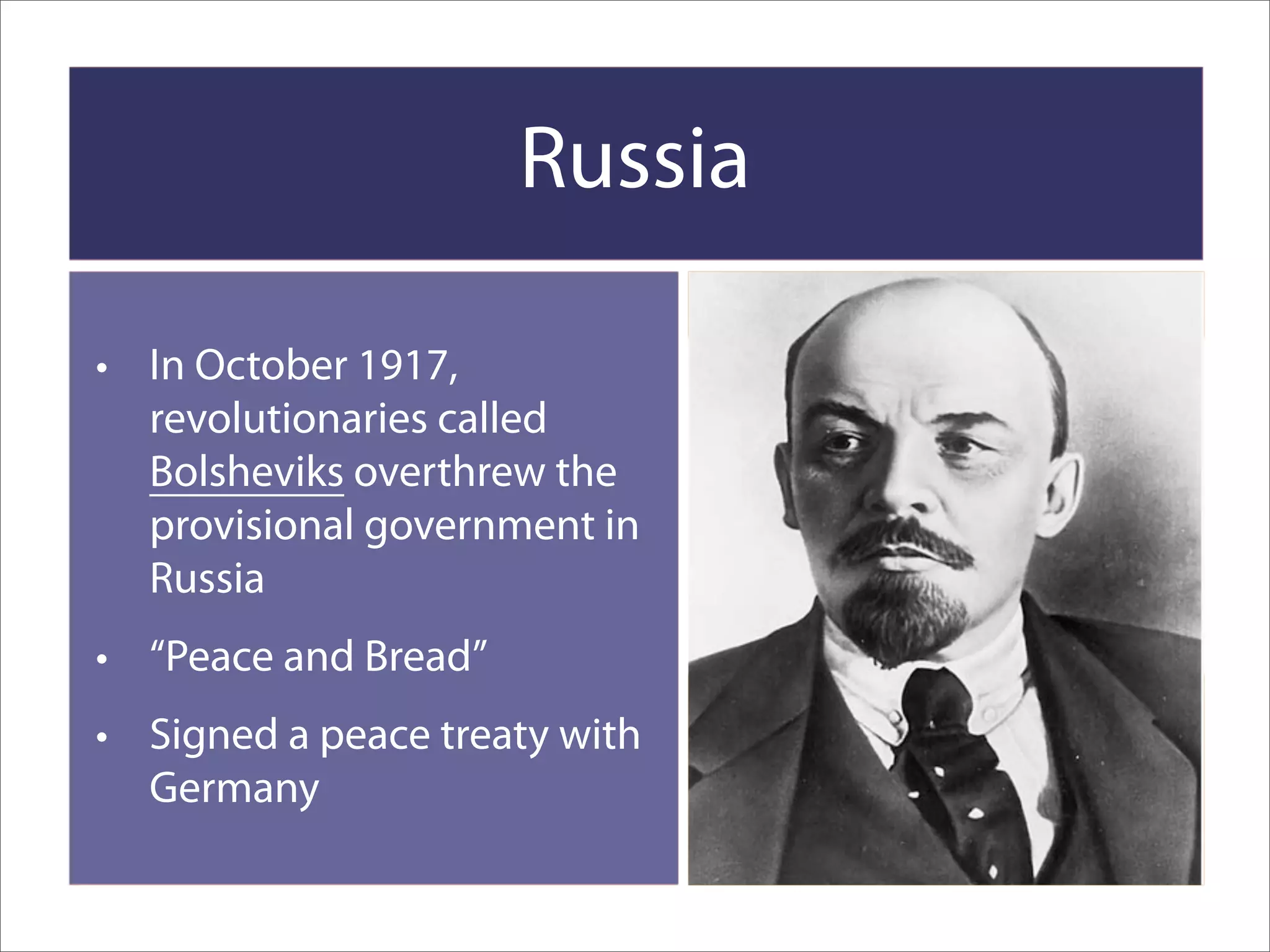
The internal dynamics of the Central Powers were a complex mix of cooperation and tension. Germany's military leadership, particularly Generals Erich Ludendorff and Paul von Hindenburg, wielded significant influence, often dictating strategy to the civilian government. The alliance was not immune to political upheaval; the Russian Revolution of 1917 led to the Treaty of Brest-Litovsk, in which Soviet Russia withdrew from the war, freeing up German troops for the Western Front. However, this peace was precarious, and the subsequent German offensive in the spring of 1918 failed to achieve a decisive victory. The entry of the United States into the war in 1917 provided a crucial influx of troops and resources to the Allies, tipping the balance of power decisively against the Central Powers. Internal dissent, economic hardship, and war-weariness grew rapidly within the Central Powers, culminating in the German Revolution of 1918 and the abdication of Kaiser Wilhelm II.
The collapse of the Central Powers in 1918 was precipitated by a combination of military defeat, economic exhaustion, and political instability. The Allied Hundred Days Offensive, launched in August 1918, shattered the German army on the Western Front, leading to a series of cascading surrenders. Bulgaria signed an armistice in September 1918, followed by the Ottoman Empire in October. Austria-Hungary, facing internal ethnic uprisings and a disintegrating front, sought peace, leading to the Armistice of Villa Giusti in November 1918. Germany, isolated and with its navy in revolt, signed the Armistice of Compiègne on November 11, 1918, effectively ending the war. The defeat marked the end of four ancient empires—the German, Austro-Hungarian, Ottoman, and Russian—and set the stage for a new, precarious world order.
The Treaty of Versailles and subsequent peace treaties imposed harsh terms on the Central Powers, seeking to ensure they could never again threaten European stability. Germany was forced to accept full responsibility for the war, pay substantial reparations, and cede significant territories, including Alsace-Lorraine to France and parts of Prussia to the newly formed Poland. Austria-Hungary was dissolved into independent nations such as Austria, Hungary, Czechoslovakia, and Yugoslavia, while the Ottoman Empire was fragmented into modern states under British and French mandates. These punitive measures sowed the seeds of resentment and economic hardship, contributing to the rise of extremist ideologies and the outbreak of World War II. As historian Margaret MacMillan noted, "The peacemakers had failed to understand that you cannot destroy an empire and expect peace to follow." The Central Powers, once formidable, were reduced to shadows of their former selves, their legacies a complex tapestry of ambition, conflict, and profound global transformation.
Related Post
The Shattered Empire: Understanding the Collapse of the Central Powers
/pic564165.jpg)
The Forgotten Foe: Uncovering the Top Sides of the Central Powers


