The Impossible Mentality: How Bob Burnquist Redefined the Limits of Skateboarding
The Impossible Mentality: How Bob Burnquist Redefined the Limits of Skateboarding
Bob Burnquist does not merely ride a skateboard; he engages in a dialogue with gravity, often choosing to answer it with a higher, more impossible trajectory. The Brazilian-American skater has spent two decades expanding the visual vocabulary of the sport, merging vert ramp aggression with street-style innovation in a career defined by fearless experimentation. This is the story of a man who built an empire of dust and concrete, turning the simple act of rolling on wood into high-definition artistry.
Burnquist’s journey is not just a catalog of tricks; it is a masterclass in longevity, resilience, and the relentless pursuit of the "Impossible." From his early days as a hungry newcomer to the establishment of his own legendary skate park, the story of Burnquist is the story of modern skateboarding’s evolution, where the only true limit is the one you believe in.
Born in Rio de Janeiro in 1976, Burnquist was exposed to skate culture at a young age, but it was the gritty plazas and concrete banks of São Paulo that forged his foundational skills. He moved to the United States in the early 1990s, a teenage prodigy with a raw talent that promised a spectacular career. His arrival on the scene was met with immediate recognition, winning the prestigious X Games gold medal in the Vert event in 1997. This victory was not just a trophy; it was a declaration that a new global talent had arrived, one who understood the board as an extension of his own body.
The late 1990s and early 2000s were Burnquist’s golden age, a period where he seemed to redefine what was physically possible on a skateboard. While other riders were mastering established tricks, Burnquist was scripting entirely new chapters. He became the undisputed king of the vert ramp, launching himself into the air with such height and control that the laws of physics seemed like mere suggestions. His signature "fakie heelflip indy" became a staple of his arsenal, a move so fluid and unexpected that it left spectators and competitors alike in a state of disbelief.
Burnquist’s impact, however, extended far beyond the vert ramp. He was instrumental in bridging the gap between street and vert skating, two disciplines that were often seen as separate worlds. Street skating emphasized technicality and urban terrain, while vert was about aerial dominance and speed. Burnquist refused to choose a side. He carried the aggression and technical flair of the streets to the massive ramps and, conversely, brought the fluidity and air awareness of vert to the harsh concrete of the city. This synthesis allowed him to approach obstacles with a versatile mindset, viewing a staircase, a handrail, or a quarter-pipe not as distinct challenges, but as components of a single, fluid landscape.
One of the most defining moments of his career came in 2004, at the X Games in Los Angeles. Burnquist competed in the Skateboard Big Air event, a competition that demands a single, awe-inspiring trick to win the crowd and the gold. Facing immense pressure, he rolled up to the ramp and launched himself into a frontside heelflip 720. The trick—a double backflip with two and a half rotations—was a blur of athleticism and skill. As he landed cleanly and rode away, the arena erupted. The scoreboard confirmed what the audience already knew: he had not just won; he had conquered the impossible.
- **Innovation as Standard:** Burnquist consistently introduced maneuvers that were once thought impossible, forcing the entire industry to evolve and adapt.
- **Mental Fortitude:** Success in skateboarding requires an immense tolerance for pain and failure, a lesson Burnquist learned through countless falls and injuries.
- **The Business of Dreams:** Understanding the fleeting nature of a professional athletic career, Burnquist invested in a legacy project that would outlive his time on the board.
Perhaps the most profound testament to Burnquist’s vision is the creation of "The Dreamland" in 2013. Located in the rural outskirts of São Paulo, this private skate park is more than a collection of ramps and rails; it is a meticulously crafted piece of art and engineering. Dreamland features the "Megaramp," a colossal structure that stretches over 1,300 feet, with a vert wall soaring 45 feet high. It is a playground designed for the most ambitious tricks in skateboarding history. The park was built not for competition, but for creation. It is a space where the skater’s imagination is the only boundary, a place to film content, experiment with new lines, and simply enjoy the pure joy of movement.
Dreamland represents a shift in Burnquist’s focus. As his competitive career naturally wound down, his passion did not wane; it transformed. The park became his new canvas, a place to mentor the next generation of riders and to pursue projects that were impossible in the context of a crowded and commercialized skate park. In a 2016 interview with *Thrasher* magazine, Burnquist articulated this philosophy, stating, "Skateboarding for me is not about the competition. It’s about the creation. It’s about going out there and making lines that have never been made before. Dreamland is the place where you can actually do that without limits."
This relentless drive to create, to push the envelope, and to leave a tangible mark on his sport, defines Bob Burnquist’s legacy. He is a five-time X Games gold medalist, a ten-time World Champion, and a pioneer who refused to be categorized. His career serves as a powerful reminder that mastery is not a destination but a continuous journey of elevation. Burnquist taught a generation that a skateboard is not just a toy, but a tool for innovation, a vehicle for self-expression, and a means to literally rise above one’s surroundings.
His story is filled with moments of breathtaking execution and the physical toll that accompanies such ambition. He has suffered severe injuries, including a near-fatal accident in 2011 that left him in a coma with a shattered shoulder and a punctured lung. Yet, each time, he returned. This resilience is a core part of his narrative. It underscores a truth about the sport and the athlete: the line between glory and disaster is often perilously thin, and the will to stand back up is the ultimate trick.
Today, as he continues to ride and create at his beloved Dreamland, Burnquist remains a relevant and vital figure. He is a living legend, not because of his past accolades, but because of his unwavering commitment to the future of skating. He embodies the spirit of a sport that is constantly reinventing itself, proving that passion, when fused with extraordinary talent and vision, can indeed move mountains—or at least, make them look very small.
Related Post
The Unstoppable Rise of Bob Burnquist: How a Brazilian Skateboarder Rewrote the Limits of the Sport
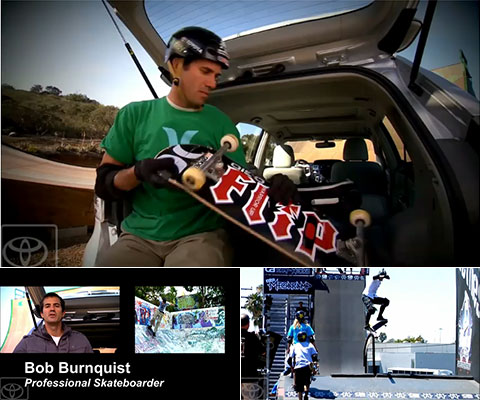
Bob Burnquist: The Skate Terrain Visionary Who Redefined Freestyle Skating Forever