The Midnight Ride and the Man Beyond the Myth: Unpacking Paul Revere’s Enduring Legacy
The Midnight Ride and the Man Beyond the Myth: Unpacking Paul Revere’s Enduring Legacy
Often immortalized in a single, silvery moment, Paul Revere’s legacy extends far beyond a midnight gallop. He was a master artisan, a key organizer of resistance in pre-Revolutionary Boston, and a pragmatic businessman whose life captured the complex transition from colonial subject to American citizen. This is the story of the man, the myth, and the meticulous craftsmanship that defined his enduring place in the American narrative.
The Craftsman: A Life Forged in Silver and Skill
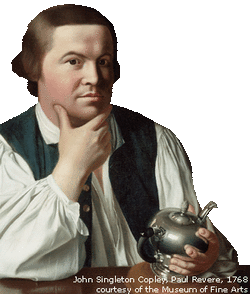
Before he became a symbol of patriotic defiance, Paul Revere was a highly skilled artisan. Born in Boston’s North End in 1735, he was apprenticed to his father, a French-born silversmith. He inherited the family business and built a reputation for producing high-quality, ornate silverware, tea sets, and engraved commissions. His work was not merely decorative; it was a testament to technical mastery in an era where luxury goods were a sign of status and success.
- Technical Innovation: Revere was an early adopter of copper rolling technology, which he used to manufacture church bells and copper sheathing for ships. This venture was so successful it allowed him to financially support his revolutionary activities.
- Community Integration: As a successful artisan, Revere was deeply embedded in Boston society. He was a deacon at the Old North Church, a member of the local Masonic lodge, and a community leader, providing him with a broad network of contacts and influence.
“He was a maker of things, a doer,” notes historian David Hackett Fischer in his Pulitzer-winning book Paul Revere’s Ride. “His skill with his hands gave him a practical understanding of materials and mechanics that would translate directly into his work as a messenger and organizer. He was a man of order and precision.”
The Organizer: Architect of Resistance
As tensions with Great Britain escalated in the 1760s and 1770s, Revere transformed from a craftsman into a key operative in Boston’s Sons of Liberty. He was not a lone voice but a central node in a clandestine communication network. His role involved everything from safeguarding gunpowder stores to gathering intelligence on British troop movements. He understood that information was as critical as ammunition in the coming conflict.
- The Boston Committee of Correspondence: Revere was a founding member of this shadow government, which coordinated resistance and shared information among the colonies.
- The “Mechanic” Network: He led a group of fellow artisans, apprentices, and laborers who acted as couriers, spies, and propagandists, disseminating revolutionary pamphlets and news via underground channels.
- The Tea Party: Revere was trusted enough to be one of the “Mohawks” who boarded the Dartmouth and other ships in December 1773, underscoring his reliable and decisive nature in moments of crisis.
His effectiveness was rooted in his dual identity. To British authorities, he was a respected, law-abiding artisan—an unassuming cover. To his fellow revolutionaries, he was a trusted, tireless agent of change. He embodied the ideal of the citizen-soldier, ready to trade his silver hammer for a musket at a moment’s notice.
The Midnight Ride: Fact vs. Folklore
On the evening of April 18, 1775, Revere’s meticulously cultivated network went into action. Upon learning of the impending movement of British regulars from Boston to Concord, Joseph Warren tasked Revere and William Dawes with riding to warn John Hancock and Samuel Adams in Lexington and to alert the colonial militia.
The famous poem by Henry Wadsworth Longfellow, “Paul Revere’s Ride,” published in 1861, cemented a specific version of events in the American consciousness. It portrays Revere as a lone hero, shouting “The British are coming!” as he gallops through the night. The reality, while perhaps less poetic, is far more representative of a coordinated effort.
- The Signal: Revere’s ride began with a pre-arranged signal from the Old North Church: one lantern for a land route, two for a sea route. That night, two lanterns were hung, indicating the British would take the faster water route.
- A Team Effort: Revere was not alone. He set out with Dawes, and they were later joined by Dr. Samuel Prescott. The trio spread the alarm across a wide swath of Middlesex County.
- The Capture: Revere was eventually captured by a British patrol near Lexington. While Dawes and Prescott escaped to complete the mission, Revere was released the next day and returned home, his role fulfilled.
Revere himself never claimed his ride was a solo affair. In his own carefully kept records, he presented his actions as part of a disciplined, intelligence-driven operation. The goal was not to be a legend, but to ensure the colonial forces were forewarned. And warn them he did.
Beyond the Ride: The Unsung Hero of Industry and Nation-Building
Perhaps the most profound aspect of Revere’s legacy is what he did *after* the Revolution. He returned to his silversmith shop, but the world had changed. The new nation needed a different kind of builder. Revere applied the same diligence that made him a revolutionary organizer to the burgeoning American economy.
He pioneered the industrialization of copper manufacturing in the United States. His rolling mill supplied the copper for the original dome of the Massachusetts State House and the sheathing for the USS Constitution, famously known as “Old Ironsides.” He also ran a nail factory, a bronze foundry, and even a grist mill, embodying the self-made, industrious citizen that the new republic idealized.
“After the war, Revere became the very engine of American commercial development,” writes historian Thomas H. Parker. “He was the personification of the American dream—a foreign immigrant’s son who, through talent and perseverance, helped forge the material foundation of a new nation.”
Enduring Legacy: The Man, The Myth, The Message
Paul Revere died in 1818, nearly four decades before the publication of Longfellow’s poem turned him into a national icon. Yet, both the man and the myth serve as powerful symbols. The man represents civic duty, technical skill, and community leadership. The myth represents the power of ordinary citizens to take extraordinary action in the face of tyranny.
To study Paul Revere is to understand a pivotal moment in American history not through grand declarations alone, but through the lens of a single, multifaceted individual. He reminds us that behind every world-changing event are the quiet, competent hands of people like him—skilled, dedicated, and ready to ride into the night when duty calls.
Related Post

Unveiling Paul Revere's Height: The Surprising Insights That Have Historians Rethinking American Heritage
Who Is Still Alive From Paul Revere And The Raiders: A Blast from the Past

Who Is Still Alive From Paul Revere And The Raiders? A Ride Through the Ages
Unveil The Voice Behind The Iconic Paul Revere The Raiders