Ultimate Guide to Devil Fruit Types: Paramecia, Zoan, Logia and the Limitations Every User Faces
Ultimate Guide to Devil Fruit Types: Paramecia, Zoan, Logia and the Limitations Every User Faces
Devil Fruits define power structures, economies, and even fashion within the world of One Piece, categorizing abilities into three primary types. This guide examines the mechanical and narrative functions of Paramecia, Zoan, and Logia, analyzing their strengths, weaknesses, and the strategic frameworks that govern their use. Understanding these classifications is essential to comprehending the balance of power in the Grand Line.
The Classification System and Its Narrative Purpose
In the fictional universe created by Eiichiro Oda, Devil Fruits are magical entities that grant consumers extraordinary powers at the cost of losing the ability to swim. These powers are not random; they are systematically categorized by type to establish rules, limitations, and tactical depth. The classification moves beyond simple "superpowers" to create a rock-paper-scissors dynamic that drives both combat choreography and character development. This system allows the narrative to maintain tension and logic, even within a world governed by absurd and fantastical elements.
Paramecia: The Most Common and Versatile Category
Paramecia is the most prevalent type of Devil Fruit, encompassing a vast array of abilities that modify the user's body, manipulate external forces, or produce substances. Unlike the other types, Paramecia offers near-infinite variety, limited only by the user's creativity. These fruits often provide defensive or utility-based advantages rather than straightforward offensive power.
Mechanics and Characteristics
Paramecia users typically alter their physical form or generate/manipulate materials. The defining feature is the alteration of the user's own body or the environment in specific, often physics-defying, ways. While some Paramecia offer raw power, many are defined by their unique utility.
- Body Modification: Users alter their limbs or features for combat, such as Luffy's Gum-Gum Fruit, which stretches his body to extreme lengths.
- Element/Particle Manipulation: Abilities that generate or control specific materials, like Doflamingo's String-String Fruit, which creates strings to control others like puppets.
- Spatial Manipulation: Fruits that affect distance, trajectory, or dimensions, such as Trafalgar Law's Room-Room Fruit, which creates a spherical space where he can swap positions of objects or people.
Strategic Advantages
The strength of a Paramecia lies in its application. A creative user can turn a seemingly simple ability into a devastating weapon. The "awakening" of a Paramecia, a rare occurrence, allows the user to alter the environment itself, not just their body, making them incredibly difficult to defeat in a battlefield composed of their element.
Zoan: The Purity of Transformation
The Zoan type focuses on transformation, allowing the user to change into a specific animal or a hybrid of their animal and human form. These fruits are often associated with brute strength, speed, and instinct, making them favorites among fighters who rely on physical power.
Sub-Categories and Power Scaling
Zoan fruits are often discussed in terms of their "rank," which dictates the potential power and complexity of the transformation.
- Standard Zoan: Allows transformation into a single animal. (e.g., Mr. 4's Miss Merry Christmas, who uses a bazooka as a dog).
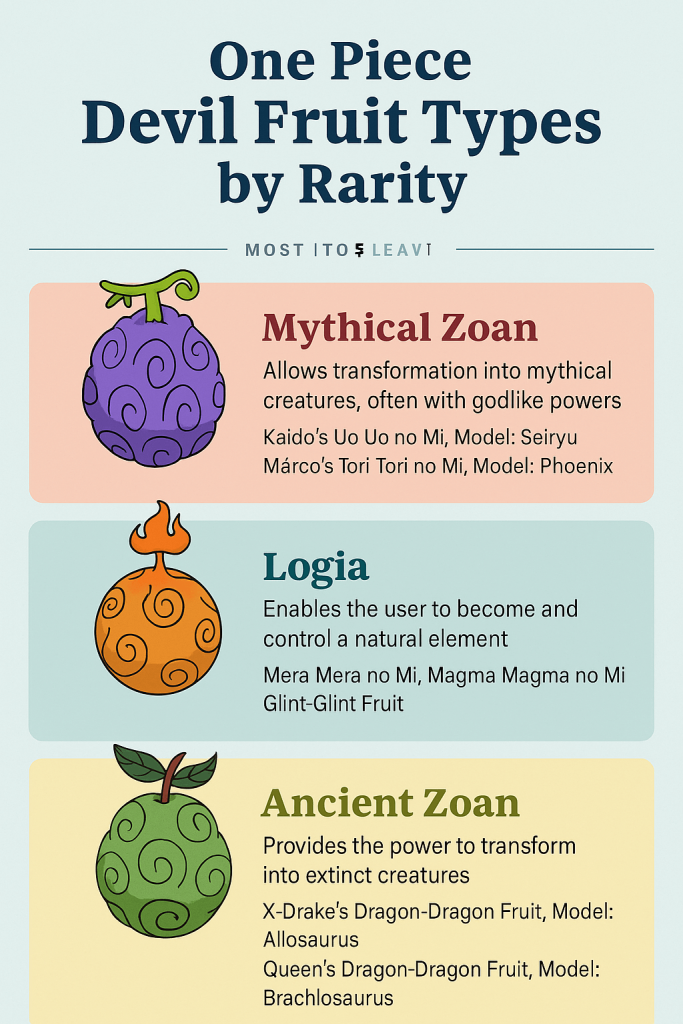
- Ancient Zoan: Allows transformation into extinct or prehistoric creatures, generally offering larger and more powerful forms (e.g., King (One Piece)'s Allosaurus form).
- Mythical Zoan: The rarest category, allowing transformation into legendary creatures or altering the user's biology in supernatural ways (e.g., Marco the Phoenix, who can transform into a phoenix, granting regeneration).
Tactical Use
Zoan users excel in direct confrontation. The ability to increase size, mass, and physical attributes makes them formidable in head-on battles. Hybrid forms allow for the retention of intelligence and weapon usage while gaining the physical advantages of the animal, such as enhanced senses or claws.
Logia: The Conceptual Elemental Power
Logia is widely considered the most powerful of the three types, granting the user control over a natural element or concept, as well as the ability to transform their body into that element. This provides unparalleled defensive capabilities and mobility.
The Pinnacle of Defense and Offense
Logia users can become the element they control, making them intangible to all but the strongest attacks. Logia fruits operate on a "Elemental Absorption" principle; physical attacks pass harmlessly through the user, while the user can manipulate the element around them to attack.
- Elemental Body: The user can transform their entire body into the element (e.g., Enel's Rumble-Rumble Fruit, becoming lightning; Aokiji's Ice-Ice Fruit, becoming ice).
- Environmental Control: The user can generate, manipulate, and control the element externally, regardless of the environment (e.g., Akainu's Mag-Mag Fruit, turning the environment into magma).
- Weakness Nullification: Logia users are immune to conventional damage. To harm them, one must use Haki, a counterintuitive ability, or a power specifically designed to bypass elemental intangibility.
The Risk of Consumption
Despite their power, Logia fruits carry a significant narrative risk. Because the user essentially becomes the element, clever opponents can use the environment against them. For example, removing oxygen to suffocate a smoke user or introducing a second element that disrupts the first (like water dispersing smoke) can bypass the standard defense.
The Devil and the Details: Standard Weaknesses and The Will of D.
Regardless of the type, all Devil Fruit users share universal vulnerabilities and are governed by the fundamental "Sea Stone" principle.
The Universal Limitations
The primary weakness is the sea water; it nullifies the fruit's power and drains the user's energy. Similarly, Sea Prism Stone (Seastone) mimics this effect, effectively neutralizing a fruit user by nullifying their Devil Fruit abilities. Furthermore, users cannot swim, presenting a critical logistical problem for ocean traversal.
- Weakness to Sea Water and Sea Prism Stone.
- Inability to swim.
- Initial difficulty in activating the power (though this is often overcome through training).
The Future of Power: An Unknown Equation
The world of One Piece constantly evolves, and with it, the understanding of Devil Fruits. The introduction of the "Ancient Giants" and the various awakened states suggest that the classifications are not static. The discovery of Nika, the Warrior of Liberation, a mythical Zoan with reality-warping properties, demonstrates that the boundaries of these types are still being tested. The pursuit of understanding these powers remains a central conflict in the narrative, driving the ambitions of pirates, marines, and revolutionaries alike.
Related Post

One Piece: A Comprehensive Guide to All Devil Fruit Types

10 Insane Devil Fruit Types You Never Knew Existed

The Great Debate: Zoan, Logia, and Paramecia - Decoding the Mysterious Devil Fruit Types