Usps Informed Delivery: Your Digital Preview Of Mail That Masters Mailroom Management
Usps Informed Delivery: Your Digital Preview Of Mail That Masters Mailroom Management
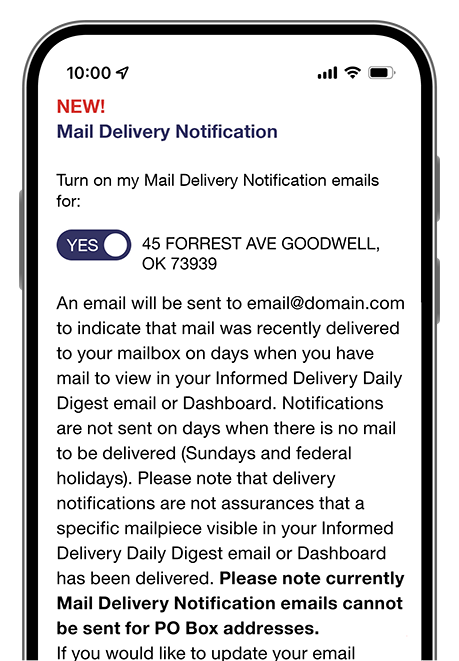
Informed Delivery is the U.S. Postal Service’s free digital notification service that provides eligible residential customers with a grayscale image preview of incoming mailpieces and a daily chronological listing of mail expected to arrive. Launched nationally in 2018 and built on technologies tested in select markets since 2014, the service helps users track physical mail flow, plan for expected checks or payments, and reduce concerns about missing items. It is distinct from package tracking, focusing only on letter-size pieces and flats that pass through automated processing equipment capable of optical character recognition.
Technologically, the system relies on high-resolution imaging machines at network choke points that capture the exterior of each eligible piece while preserving a clear, albeit black-and-white, visual record for digital delivery. Users must enroll via the USPS website, link a valid residential address, verify their identity through security questions or two-factor authentication, and maintain an active email account to receive the daily digest. While participation is free, it is not available for P.O. boxes, commercial addresses, or to every household depending on the specific equipment and configurations at local processing facilities.
Beyond personal convenience, Informed Delivery has become a practical tool for small businesses, property managers, and community organizations seeking to reduce inbound inquiries about missing mail. Legal and financial institutions rely on the timestamped images for compliance records, while families use the notifications to verify that elderly relatives are receiving expected correspondence. The service has therefore evolved into a quiet but important layer of mail visibility in an era of mixed digital and physical communications.
How Informed Delivery Works Behind The Scenes
When a piece of mail enters a network facility that supports Informed Delivery, a flatbed imaging machine photographs the envelope or card as it passes along the sorting belt, usually on the same day it is processed. These images are stripped of any personally identifiable information beyond the name and address printed on the piece and are stored in the USPS system for a limited period accessible only to the enrolled recipient. Each image is linked to an entry in the recipient’s Informed Delivery dashboard, where users can see a chronological strip of grayscale thumbnails along with the piece type, such as letter, catalog, or postcard.
Enrollment requires a precise address match and often includes a confirmation step that may ask for the last four digits of a Social Security Number, a CAPTCHA challenge, or a one-time code sent to an existing email address. Once activated, the daily email or web dashboard entry lists every imaged item with an estimated delivery time frame, helping recipients anticipate when checks, bills, or marketing materials will appear in their physical box. Because the system depends on the presence of optical characters and standardized processing equipment, some irregularly shaped items, excessively damaged mail, or pieces handled outside automated lanes may not produce an image.
Users can navigate the Informed Delivery interface to scroll through past images, with the archive typically retaining data for a rolling period of several weeks, which allows for basic reconciliation of missing or misdelivered items. For households that receive large volumes of mail, the service can function as an early warning system, signaling when a statement, medical result, or subscription card is in transit. Businesses have also integrated the imagery into internal audits, using the timestamped previews to confirm that expected mailings such as customer statements or vendor invoices are proceeding through the mail stream as planned.
Advantages For Households And Small Businesses
For everyday households, Informed Delivery reduces the anxiety of wondering whether a check from a relative, a bill from a creditor, or an invitation has actually left the sender and is on its way. Parents can verify that school notices or vaccination records are arriving, while older adults who may receive critical medical information benefit from an additional layer of oversight without needing to check the box each morning. The service is particularly valuable for people who alternate between digital and physical billing, because it provides a visual cross-check that can catch misrouted statements or early arrivals.
Small businesses and nonprofit organizations gain operational benefits by using Informed Delivery to confirm that outreach materials, promotional postcards, or direct mail fundraising pieces are moving through the system as intended. Marketing teams can correlate image arrival patterns with campaign timelines, while administrative staff can reduce time spent on voice calls from customers asking whether their mail came in. In combination with USPS Informed Delivery for Business, which offers richer analytics and integration options, the basic consumer service acts as a scalable, low-cost visibility layer across diverse mail streams.
Property managers and community associations have also adopted the service to ensure that residents receive leases, maintenance notices, or emergency communications without repeated follow-up requests. By reviewing the daily images, staff can confirm that mailed packets actually reached the addressed unit’s mailbox rather than being redirected or intercepted. This use case underscores how a seemingly simple notification tool can support governance, compliance, and resident satisfaction when paired with clear communication about the service.
Limitations, Privacy Considerations, And Complementary Tools
Informed Delivery is not a delivery confirmation service, nor does it guarantee that a piece was opened or read by the recipient; it only confirms that the exterior of a mailpiece was imaged by processing equipment and that delivery is likely imminent. Some users may notice that not every item appears with perfect clarity, particularly if the envelope surface is shiny, oddly shaped, or printed with dense dark patterns that confuse the imaging algorithms. Seasonal peaks, facility outages, or upgrades can also lead to gaps in the image timeline, which may prompt questions about whether a piece was lost when it was simply not captured on a given day.
Privacy advocates have noted that the service stores images of mailed correspondence centrally and that access controls, while designed to be robust, remain ultimately dependent on the security practices of individual users and their email providers. Because the system requires trust that mail imagery is handled in accordance with USPS data policies, some organizations subject to strict record-keeping or confidentiality rules conduct internal assessments before encouraging broad employee enrollment. The USPS has stated that mail image data is used primarily for delivery facilitation and customer service, though like many digital services, it may be subject to lawful requests in accordance with applicable statutes.
To maximize the value of Informed Delivery, many users combine it with other tracking mechanisms such as certified mail, return receipt confirmation, or third-party address verification services for high-value shipments. Businesses often layer the image data with their own customer relationship management systems to correlate mail receipt with service calls, sales cycles, or support ticket closures. Taken as part of a broader mail management strategy, the service contributes to higher accuracy, faster dispute resolution, and more predictable outcomes for organizations that rely on physical channels.
Future Evolution And The Role Of Informed Delivery In A Multichannel System
As postal operators continue to integrate automation, address validation, and data analytics, Informed Delivery is expected to expand into richer interactions, potentially including color imaging where permitted, expanded retention windows, and tighter links with online account management portals. The ongoing shift toward hybrid mail, in which physical pieces are scanned and delivered as digital copies, also creates new possibilities for Informed Delivery to interface with secure electronic delivery options while maintaining the recipient’s choice of format. At the same time, operational constraints such as processing speed, facility capabilities, and legal considerations around imaging sensitive materials will continue to shape what the service can realistically offer.
For stakeholders across households, small enterprises, and institutional mail recipients, the core value of Informed Delivery lies in its ability to turn a traditionally opaque process into a more observable, trackable, and accountable channel. By providing a digital window into the physical flow of mail, the service helps reduce uncertainty, supports timely action on time-sensitive items, and reinforces the enduring relevance of mail in an increasingly digital world. As technology and policy evolve, Informed Delivery is likely to remain a central tool for anyone who wants to know not just that mail was sent, but that it arrived, as captured, in the hands of its intended recipients.
Related Post
Unlock USPS Informed Delivery Sign In: Your Complete Guide to Digital Mail Management
Usps Informed Delivery A Complete Guide Maximize Visibility And Control Your Mail

Unlock the Power of Usps Informed Delivery Multiple Addresses: A Game-Changer for Package Management