When Memes Go Bang: How Gun Culture Hijacked Internet Humor
When Memes Go Bang: How Gun Culture Hijacked Internet Humor
Gun memes have evolved from niche online jokes into a defining cultural language, shaping discourse around firearms, politics, and identity. These image macros and viral clips compress complex debates about rights, regulation, and violence into easily digestible, often polarizing, snippets. This report examines the anatomy, influence, and consequences of gun-centric humor in the digital age, tracing its lineage from early forums to modern social media battlegrounds.
The internet’s relationship with firearm imagery is not new. Early iterations of gun memes emerged from subcultures valuing technical jargon and insider humor. As platforms evolved, so did the sophistication and reach of these visual jokes. Understanding their mechanics reveals a great deal about contemporary communication and societal friction.
The Anatomy of a Viral Joke: Deconstructing the Meme
A gun meme is rarely just a picture of a weapon. It is a carefully constructed piece of communication that relies on shared context, emotional resonance, and often, dark humor. These elements combine to create a potent vessel for ideology and commentary.
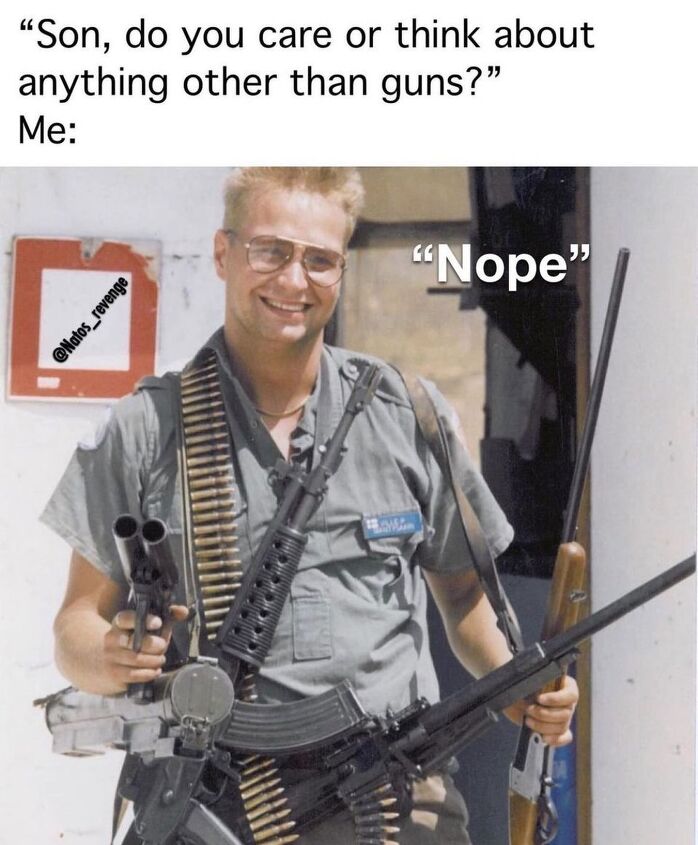
* **The Image:** This is the foundation. It can be a historical photograph, a screenshot from a video game, a piece of stock art, or a candid photo of a public figure. The choice is strategic. For example, a stoic military portrait provides a stark contrast to a caption about modern "snowflakes."
* **The Text:** Overlay text provides the punchline or the message. The font is almost always bold and simple, ensuring readability even when the image is shared in a tiny preview. The tone is frequently ironic, sarcastic, or defiant.
* **The Context:** The meme’s power lies in its relationship to current events. A politician’s statement on gun control, a mass shooting, or a viral news clip can serve as the catalyst. The meme then offers a specific, often predetermined, interpretation of that event for its audience.
These components form a closed loop of communication. For the initiated, the message is immediate and clear. For the uninitiated, it can be confusing or seem needlessly aggressive. This exclusivity reinforces in-group identity.
Humor as a Vector for Ideology
Laughter creates a powerful bond. When people share a joke, they align themselves with the joke’s perspective. Gun memes leverage this psychological trick to reinforce specific worldviews and spread persuasive messaging.
The primary function of many gun memes is to build community. They act as shibboleths—secret passwords that signal belonging. A meme about "Range Hygiene" or the proper way to hold a rifle is funny to enthusiasts because it is true. It validates their identity and shared experience. As one online community manager noted, "The joke is just the wrapper for the tribal affiliation. Everyone who gets the punchline is one of us."
However, this community-building often exists in opposition to an out-group. Memes frequently frame gun owners as besieged defenders of liberty against a faceless, tyrannical government. This "us versus them" dynamic is a recurring theme. The humor provides a layer of plausible deniability. The message is about "tyranny" or "disarmament," but it is delivered via a cartoonish image, making it easier to dismiss criticism as a lack of humor or an overreaction.
The Grey Area: Harassment and Radicalization
Not all gun memes are benign attempts at humor. A darker subset exists that weaponizes humor to harass individuals and normalize extremist ideologies. These memes move from commentary to threat, blurring the line between joke and menace.
The targets are often activists, journalists, and politicians advocating for gun control. These individuals, particularly women and people of color, frequently face coordinated campaigns of online abuse. The abuse is often packaged in a "funny" meme format.
* **The Threat Masquerading as a Joke:** A meme might depict a politician with a target on their forehead, paired with a caption implying violence. The humor claim allows the creator to deflect accountability, stating they were "just kidding" or "making a meme."
* **Glorification of Violence:** Some memes celebrate past tragedies or depict violent scenarios involving guns. While framed as "dark humor," these images can desensitize viewers and create an environment where violence is seen as a legitimate political tool.
* **Radicalization Pipeline:** For individuals already sympathetic to extremist views, these memes serve as a powerful recruitment tool. They present a world where the "good guys" (often depicted as hyper-masculine, heavily armed) are constantly under attack. The constant stream of "us vs. them" humor normalizes the language of conflict and prepares the ground for more extreme beliefs.
This use of humor is not an aberration; it is a strategy. By wrapping hateful or violent imagery in the familiar and dismissive format of a meme, bad actors can spread their ideology to a wider audience, especially younger generations who consume a vast amount of their information online.
The Platform Paradox: Moderation in the Digital Wild West
The spread of gun memes highlights the immense challenge social media platforms face in moderating content. These images are often a gray area—political speech, humor, and threats can all exist within the same image.
Platforms like Facebook, X (formerly Twitter), and Instagram have struggled to create consistent policies. The core dilemma is balancing free expression with user safety.
* **Context is King (and Queen):** A meme of a rifle with the text "For hunting" might be acceptable. The same image with the text "For politicians" might violate rules against threats. Determining intent requires context that algorithms struggle to understand.
* **The Streisand Effect:** Attempts to remove particularly viral or inflammatory memes often backfire. The act of removal draws attention to the content, leading to its wider dissemination. Users who see the removal may perceive it as censorship, further solidifying their existing beliefs.
* **The Whack-a-Mole Problem:** Bad actors constantly adapt. When one meme is removed, they create a new variation. The volume of content is so high that full moderation is arguably impossible. Platforms are caught in a reactive cycle, struggling to stay ahead of the deluge.
This regulatory vacuum means that the "governing" of gun memes often falls to the users themselves, through reporting features and community backlash. The effectiveness of these decentralized systems is highly inconsistent.
The Echo Chamber and the Real World
The most significant impact of gun memes is their role in creating polarized realities. For users on one side of the debate, the meme ecosystem is a source of validation and community. For users on the other side, it is a landscape filled with threats and absurdity. This divergence in perception makes constructive dialogue incredibly difficult.
When nuanced policy discussions are reduced to slogans and jokes, the space for compromise shrinks. The memes reinforce existing biases, making it harder for individuals to see the legitimacy of opposing viewpoints. They simplify a multifaceted issue into a binary "good vs. evil" narrative.
The line between the online world and the offline world is porous. The normalization of gun culture through humor contributes to a broader cultural landscape where firearms are increasingly present. While most meme consumers will never commit a violent act, the cumulative effect of constant exposure is a shift in the cultural baseline. What was once unthinkable becomes, for some, a subject of casual, even celebratory, humor.
The gun meme is more than an online joke. It is a cultural artifact that reflects, shapes, and polarizes our society. It is a tool for community, a vector for ideology, and sometimes, a shield for harassment. As long as the debate over firearms continues, the memes will continue to evolve, providing a darkly comedic lens through which we view one of the most contentious issues of our time.
Related Post

The Rise of Funny Gun Memes: A Reflection of Societal Sentiment
When Gun Memes Wield Power: Exploring the Complex Relationship Between Internet Culture and Gun Control