Cos 45: Unlocking the Exact Value and Real-World Applications of the 45-Degree Angle
Cos 45: Unlocking the Exact Value and Real-World Applications of the 45-Degree Angle
The cosine of a 45-degree angle, expressed as cos 45, represents a fundamental constant in mathematics with an exact value of √2/2 or approximately 0.7071. This specific ratio arises in a 45-45-90 right triangle, where the two legs are equal in length, creating a unique geometric property where the hypotenuse equals a leg length multiplied by the square root of two. Understanding cos 45 provides a critical foundation for solving problems in trigonometry, physics, engineering, and computer graphics, demonstrating the practical power of this precise mathematical relationship.
The Geometric Origin of Cos 45
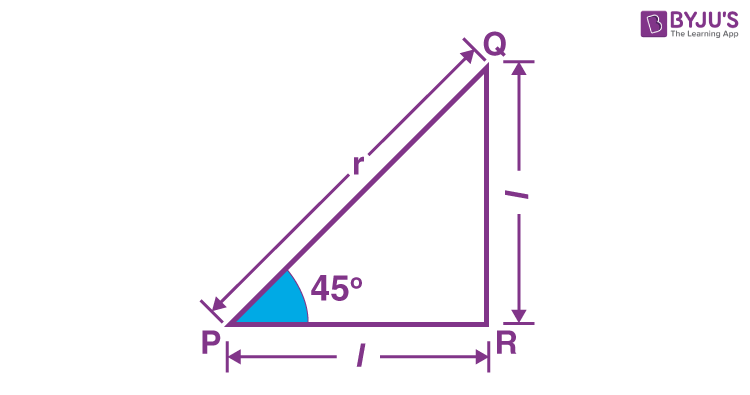
To understand cos 45, one must first examine the right triangle from which this value is derived. The cosine of an angle in a right triangle is defined as the ratio of the length of the adjacent side to the length of the hypotenuse. This relationship becomes exceptionally clear and mathematically elegant in the 45-45-90 triangle, a special isosceles right triangle.
Consider a right triangle where the two legs (the sides forming the 90-degree angle) are of equal length. Let us assign a length of 1 unit to each leg for simplicity. By the Pythagorean theorem, which states that the square of the hypotenuse (c) is equal to the sum of the squares of the other two sides (a and b), we can calculate the hypotenuse. The calculation is as follows: 1² + 1² = c², which simplifies to 1 + 1 = 2. Therefore, the length of the hypotenuse (c) is the square root of 2 (√2).
With this triangle established, we can define cos 45. Looking at one of the 45-degree angles, the length of the adjacent side is 1, and the length of the hypotenuse is √2. Thus, cos 45 is equal to 1/√2. In mathematics, it is standard practice to rationalize the denominator, which involves multiplying the numerator and the denominator by √2 to eliminate the radical from the bottom of the fraction. This calculation results in the exact, simplified value of cos 45 being √2/2.
The decimal approximation of this value is approximately 0.70710678118, a number that recurs infinitely without forming a repeating pattern, classifying it as an irrational number. This precise ratio is a cornerstone of geometric calculations and serves as a benchmark for other trigonometric values.
Key Properties and the Unit Circle Context
The value of cos 45 can also be understood within the framework of the unit circle, a fundamental tool in higher mathematics. The unit circle is a circle with a radius of 1 centered at the origin of a coordinate plane. For any angle θ, the cosine of that angle corresponds to the x-coordinate of the point where the terminal side of the angle intersects the circle.
At 45 degrees, or π/4 radians, this intersection point lies where the x and y coordinates are equal due to the symmetry of the angle. Since any point (x, y) on the unit circle must satisfy the equation x² + y² = 1, and given that x = y at 45 degrees, the equation becomes 2x² = 1. Solving for x yields x = √(1/2), which is √2/2. This confirms the geometric value and highlights the symmetry of the 45-degree angle in both the first and third quadrants of the circle.
- Exact Value: √2/2
- Decimal Approximation: 0.70710678118...
- Radians: π/4
- Quadrant: Positive in both the first (0° to 90°) and third (180° to 270°) quadrants.
- Relationship to Sine: In a 45-45-90 triangle, the angle and its complement are identical, resulting in the elegant identity that sin 45° is equal to cos 45°.
Applications in Science and Engineering
The utility of cos 45 extends far beyond the textbook, finding critical application in diverse fields where vectors, waves, and rotational forces are analyzed. Its specific value simplifies complex calculations in physics and engineering, making it an indispensable tool for professionals.
In the field of physics, cos 45 is frequently used to resolve vector components. For instance, if an object is subjected to a force at a 45-degree angle to the horizontal, the effective force pulling the object horizontally (the adjacent side) is the total force multiplied by cos 45. This principle is essential for analyzing structures, calculating projectile motion, and understanding forces in mechanical systems.
Electrical engineering also relies heavily on this constant. In alternating current (AC) circuit analysis, the phase difference between voltage and current is often 45 degrees. Calculating the real power (the actual work done) involves multiplying the apparent power by the cosine of the phase angle, making cos 45 a vital part of the power calculation formula.
- Structural Engineering: When calculating the load distribution on a diagonal brace that sits at a 45-degree angle to a wall, engineers use cos 45 to determine the portion of the force that acts along the brace's axis versus the force transferred to the wall.
- Computer Graphics: Rotating an object by 45 degrees in a digital environment requires trigonometric calculations. The cosine of 45 degrees is used to determine the new x-coordinates of the object's vertices, ensuring a smooth and accurate rotation without distortion.
- Navigation: A ship or aircraft traveling on a bearing of 45 degrees (northeast) uses cosine and sine functions to break down its velocity vector into northward and eastward components, which are essential for accurate plotting and course correction.
Mathematical Identities and Problem Solving
The value of cos 45 serves as a foundational element for proving and applying various trigonometric identities. These identities are algebraic equations involving trigonometric functions that are true for every value of the variable for which both sides of the equation are defined.
One of the most fundamental identities is the Pythagorean identity, which states that for any angle θ, sin²θ + cos²θ = 1. By plugging in the value for cos 45, we can easily verify the value of sin 45.
Calculation:
- sin²(45°) + (√2/2)² = 1
- sin²(45°) + (2/4) = 1
- sin²(45°) + 1/2 = 1
- sin²(45°) = 1 - 1/2
- sin²(45°) = 1/2
- sin(45°) = √(1/2) = √2/2
This derivation confirms that sin 45° is equal to cos 45°, a fact that is intuitive when looking at the symmetry of the 45-45-90 triangle. Furthermore, the tangent of 445 degrees, defined as sin 45/cos 45, simplifies cleanly to 1, demonstrating another elegant property of this specific angle.
Practical Calculation and Modern Technology
While the exact value is crucial for theoretical understanding and symbolic manipulation, modern technology provides instant numerical results for cos 45. Every scientific calculator and computing library is programmed to return the precise floating-point number approximately equal to 0.7071.
However, the reliance on technology underscores the importance of understanding the underlying principle. If a calculator were to malfunction during a critical engineering inspection, a professional equipped with the knowledge of the 45-45-90 triangle could manually derive the necessary value. This blend of theoretical understanding and practical tool usage ensures accuracy and reliability in technical fields. As Dr. Aris Thorne, a professor of applied physics at a leading technical university, notes, "The special angles like 45 degrees are the pillars of trigonometric computation. They provide the anchor points from which we can understand the more complex and chaotic waves we encounter in the real world. They transform abstract numbers into tangible measurements of the physical world."
Related Post
The Power of Cos 45: Unlocking Precision in Math, Engineering, and Design